The Legacies of The Oyo Empire.
Introduction
Among the greatest political achievements in African history stands the Oyo Empire, one of the most powerful and influential states ever created by the Yoruba people. For several centuries, Oyo dominated much of present-day southwestern Nigeria and extended its influence across large portions of West Africa through military strength, political organization, diplomacy, and commerce.
At its height, the empire controlled extensive trade routes, maintained a formidable cavalry, governed diverse populations, and developed sophisticated political institutions that balanced royal authority with constitutional restraints. Its influence shaped the history of Yorubaland and contributed significantly to the political and economic development of the region.
The rise and fall of the Oyo Empire remains one of the most fascinating chapters in African history. Its achievements demonstrate the sophistication, adaptability, and statecraft of pre-colonial Yoruba civilization.
This article explores the origins, growth, administration, military power, economy, decline, and enduring legacy of the Oyo Empire.

The Origins of Oyo
The origins of Oyo are closely linked to the broader history of the Yoruba people.
According to Yoruba traditions, the founders of Oyo traced their ancestry to Ile-Ife, regarded as the ancestral homeland of the Yoruba.
Early settlers established communities in the northern parts of Yorubaland.
Over time, these settlements evolved into a powerful kingdom.
Its strategic location contributed significantly to future growth.
Geographic Advantages
Oyo benefited from favorable geographic conditions.
Its location provided access to:
- Trade routes
- Agricultural lands
- Neighboring markets
- Regional networks
Unlike some forest-based Yoruba states, Oyo occupied savanna regions suitable for horse breeding and cavalry operations.
This advantage would later become a crucial factor in military success.
Early Development of the Kingdom
The early rulers of Oyo gradually consolidated authority over surrounding communities.
They established institutions capable of:
- Maintaining order
- Collecting tribute
- Organizing defense
- Managing trade
These developments laid the foundations for future expansion.
The kingdom’s influence steadily increased.
The Alaafin: Supreme Ruler of Oyo
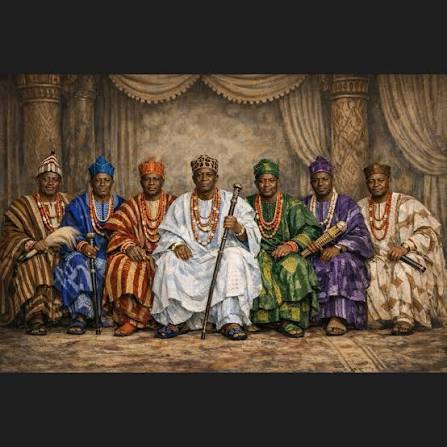
At the center of Oyo’s political system stood the Alaafin.
The Alaafin served as:
- Monarch
- Political leader
- Symbol of unity
- Custodian of tradition
The office carried immense prestige.
However, unlike absolute monarchs elsewhere, the Alaafin’s authority was balanced by other institutions.
This arrangement contributed to political stability.
The Meaning of Alaafin
The title “Alaafin” is often interpreted as “Owner of the Palace.”
The Alaafin represented the kingdom both internally and externally.
His responsibilities included:
- Governance
- Diplomacy
- Military leadership
- Religious duties
The position embodied both political and cultural authority.
The Oyo Mesi
One of the most remarkable features of Oyo governance was the Oyo Mesi.
This council consisted of senior chiefs who advised the Alaafin.
The Oyo Mesi performed important functions including:
- Policy consultation
- Political oversight
- Succession matters
The council helped ensure that power remained accountable.
Its existence reflects the sophistication of Oyo’s constitutional system.
Checks and Balances
Oyo developed a political structure that limited excessive concentration of power.
The Alaafin was influential but not unrestricted.
Institutions such as:
- The Oyo Mesi
- Religious authorities
- Military leaders
provided checks and balances.
This arrangement helped prevent arbitrary rule and promoted institutional stability.
Expansion of Oyo Power
From approximately the sixteenth century onward, Oyo expanded rapidly.
Its leaders pursued strategies involving:
- Diplomacy
- Military conquest
- Alliance-building
- Economic integration
These efforts transformed Oyo into a major regional power.
Its influence extended far beyond its original territory.
Military Strength
Military organization played a crucial role in Oyo’s rise.
The empire maintained disciplined forces capable of defending territory and expanding influence.
Military success enabled Oyo to:
- Secure trade routes
- Collect tribute
- Protect allies
The army became one of the most respected institutions within the empire.
The Famous Oyo Cavalry
One of Oyo’s greatest military advantages was its cavalry.
The savanna environment allowed the effective use of horses.
Mounted warriors provided:
- Mobility
- Speed
- Strategic flexibility
The cavalry distinguished Oyo from many neighboring states.
Its effectiveness contributed significantly to imperial expansion.
Relations with Neighboring States
Oyo interacted with numerous neighboring societies.
These relationships included:
- Trade
- Diplomacy
- Military campaigns
- Tributary arrangements
The empire’s influence extended across diverse cultural and political environments.
Successful diplomacy often complemented military strength.
Tributary System
Many neighboring communities became tributaries of Oyo.
Tributary states typically provided:
- Goods
- Resources
- Symbolic recognition
In return, they often received protection and access to trade networks.
This system strengthened Oyo’s regional influence.
Economic Foundations
Economic prosperity supported imperial growth.
The Oyo economy relied upon:
- Agriculture
- Trade
- Tribute
- Craft production
Economic strength enabled the empire to support administrative and military institutions.
Prosperity reinforced political stability.
Agriculture in Oyo
Most inhabitants engaged in agriculture.
Common crops included:
- Yam
- Millet
- Sorghum
- Vegetables
Agricultural production provided food security and economic surplus.
These resources supported urban growth and political development.
Trade and Commerce
Trade played a vital role in Oyo’s success.
Merchants exchanged:
- Textiles
- Agricultural products
- Salt
- Metal goods
- Livestock
Oyo’s strategic position enabled participation in both local and long-distance trade networks.
Commercial activity contributed significantly to state revenues.
Connections to Trans-Saharan Trade
Oyo’s location facilitated connections with broader West African trading systems.
Through intermediaries, goods moved between:
- Forest regions
- Savanna zones
- Northern markets
These exchanges expanded economic opportunities and strengthened regional influence.
Urban Development
As Oyo grew, urban centers expanded.
The capital became an important center of:
- Administration
- Commerce
- Culture
- Diplomacy
Urban development reflected the empire’s prosperity and organizational capacity.
Visitors often remarked upon the size and significance of Oyo settlements.
Religion and Spiritual Life
Religion played an important role in Oyo society.
Spiritual beliefs influenced:
- Governance
- Community life
- Festivals
- Political legitimacy
Religious institutions helped reinforce social cohesion.
They also contributed to the authority of political leaders.
Art and Culture
The empire supported artistic and cultural development.
Creative traditions included:
- Sculpture
- Music
- Textiles
- Oral literature
Cultural achievements flourished alongside political and economic success.
The arts contributed to Oyo’s prestige.
Diplomacy and Statecraft
Oyo leaders demonstrated considerable diplomatic skill.
They managed relationships with:
- Allies
- Rivals
- Tributary states
Diplomacy often reduced the need for military conflict.
This strategic flexibility contributed to imperial longevity.
Administrative Sophistication
The empire required effective administration.
Officials performed tasks involving:
- Revenue collection
- Judicial matters
- Provincial oversight
- Military coordination
Administrative structures enabled governance across extensive territories.
Their effectiveness reflected the maturity of Oyo institutions.
Social Organization
Oyo society included various social groups.
These included:
- Royal families
- Chiefs
- Farmers
- Traders
- Artisans
- Religious specialists
Each group contributed to the functioning of society.
Social organization supported both economic and political stability.
Challenges to Imperial Stability
Like all large states, Oyo faced challenges.
These included:
- Succession disputes
- Political rivalries
- External threats
- Economic pressures
Managing these difficulties required strong leadership and effective institutions.
Over time, however, the challenges became increasingly difficult to control.
Internal Political Conflicts
Political disagreements weakened the empire.
Conflicts emerged among:
- Rulers
- Chiefs
- Military leaders
These disputes reduced unity and undermined central authority.
Internal instability created vulnerabilities.
External Pressures
The empire also faced growing external threats.
Neighboring powers sought opportunities to challenge Oyo influence.
Military and political pressures intensified.
These developments contributed to long-term decline.
The Decline of Oyo
By the nineteenth century, Oyo’s power had diminished significantly.
A combination of factors contributed to decline:
- Internal conflict
- Administrative weaknesses
- External invasions
- Economic disruption
The empire gradually lost control over many territories.
Its political dominance came to an end.
Legacy of the Oyo Empire
Although the empire declined, its influence endured.
Oyo left lasting contributions to:
- Political thought
- Governance
- Military organization
- Trade networks
- Cultural identity
Its institutions shaped later Yoruba societies.
Many traditions associated with Oyo remain important today.
Influence on Yoruba Identity
The memory of Oyo continues to occupy a prominent place in Yoruba historical consciousness.
The empire symbolizes:
- Achievement
- Leadership
- Unity
- Innovation
Its history inspires pride and scholarly interest.
Lessons from the Oyo Empire
The story of Oyo offers valuable lessons:
- Strong institutions support stability.
- Economic prosperity strengthens political power.
- Leadership requires accountability.
- Unity is essential for long-term success.
- Internal divisions can undermine great achievements.
These lessons remain relevant in contemporary governance.
Historical Significance
The Oyo Empire stands among Africa’s greatest pre-colonial states.
Its achievements challenge outdated stereotypes concerning African political development.
The empire demonstrates that sophisticated governance, constitutional principles, and large-scale statecraft flourished in Africa long before colonial rule.
Conclusion
The Oyo Empire represents one of the most remarkable achievements in Yoruba and African history. Through military innovation, economic prosperity, political sophistication, and cultural vitality, Oyo rose from a regional kingdom to become a dominant power in West Africa.
Its institutions balanced authority with accountability, while its cavalry, trade networks, and administrative systems supported centuries of growth and influence. Although the empire eventually declined, its legacy continues to shape Yoruba identity and historical understanding.
Today, the story of Oyo serves as a powerful reminder of the ingenuity, resilience, and statecraft of the Yoruba people. It remains a shining example of Africa’s rich historical heritage and one of the greatest political achievements of pre-colonial civilization.